About this course
Multichannel signs are an important feature of BSL and allow several elements of meaning to be expressed at the same time. They can involve handshape, movement, facial expression, body movement, and the use of space working together as part of a single construction.
For interpreters and translators, recognising and producing multichannel signs can be important when working towards BSL that is clear, natural, and appropriate to the context. They can also present challenges, particularly when information is being expressed across several channels at once or when an English source message does not map neatly onto BSL structure.
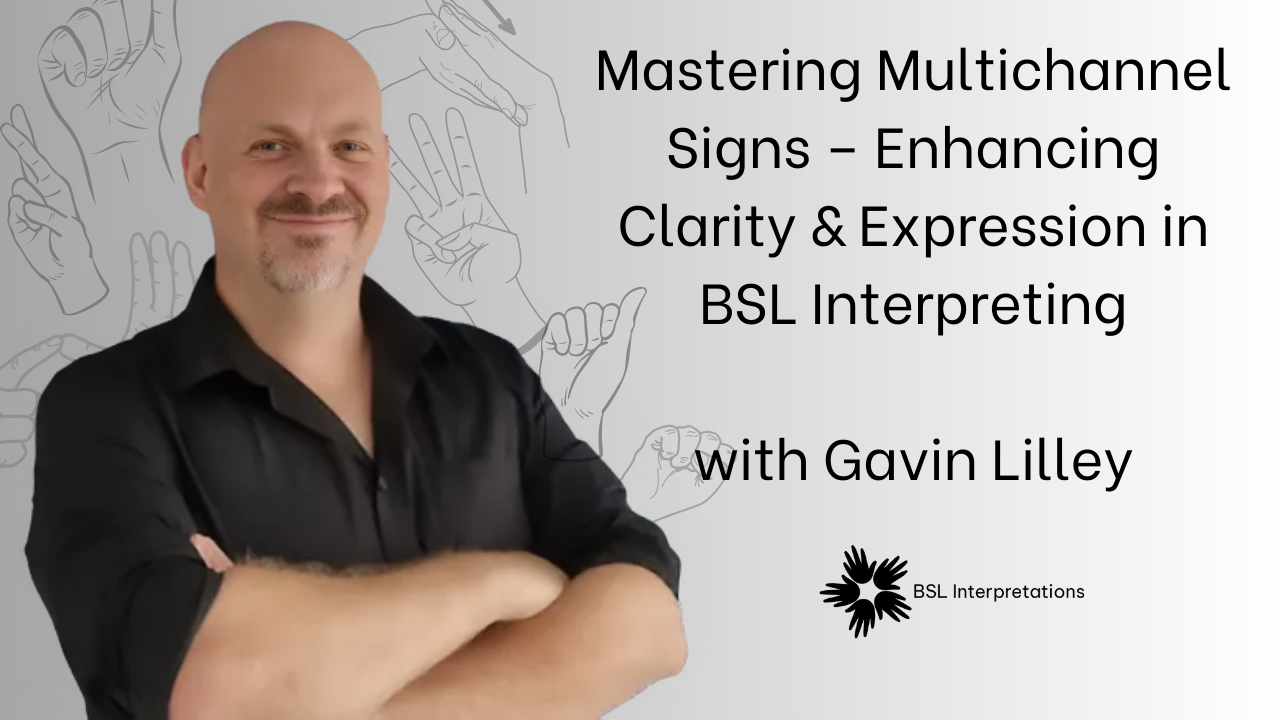
This 4-hour practical workshop is led by Deaf linguist and trainer Gavin Lilley and will look at how multichannel signs work, how they are used in BSL, and how interpreters and translators can develop their use of them in both live and prepared work.
Through demonstrations, discussion, and practical activities, participants will explore:
What multichannel signs are and how they function within BSL
How handshape, movement, facial expression, body movement, and space can work together to convey meaning
How to recognise multichannel information when watching BSL
Ways to use multichannel signs when interpreting from English into BSL
How multichannel signs can be considered within translation work
Common difficulties that can arise when producing multichannel signs
Opportunities to analyse, practise, and discuss different approaches
Activities will give attendees opportunities to watch examples, try out different constructions, receive feedback, and reflect on how multichannel signs can be incorporated into their own interpreting or translation work.
Who is this session for?
This course is designed for qualified and trainee BSL/English interpreters and sign language translators who want to develop their understanding and use of multichannel signs.
It is relevant across a range of interpreting and translation settings and is suitable for those who have encountered multichannel signs before but would like more opportunity to analyse and practise them.
Learning outcomes
- Gain a clearer understanding of how multichannel signs work within BSL
- Develop your ability to recognise information being expressed across several channels at once
- Practise producing multichannel signs in a range of examples and contexts
- Consider how multichannel signs can be used in both interpreting and translation
- Identify common difficulties and ways of working through them
- Learn directly from a Deaf linguist with opportunities for discussion, practice, and feedback
Live, interactive and supported
This is an active learning session with explanation, structured discussion and practical work. A useful course handbook or supporting materials are provided, together with a CPD certificate for each attendee.
Participation and cameras
Participation is encouraged. Cameras help people connect with those they are learning and working with, while recognising that there may be circumstances where having a camera on is not practical or appropriate.
Not recorded
This course is delivered live and is not recorded. Please book only if you can attend at the advertised time.
About the trainer

Gavin Lilley
Gavin Lilley is a Deaf Translator, BSL teacher, assessor, and trainer with more than 20 years’ experience in sign language education and professional development. A native BSL user from a multi-generational Deaf family, he brings both lived and professional experience to his teaching and training. Gavin has extensive experience teaching and assessing BSL from Levels 1 to 6 and has delivered training to thousands of learners across the UK. His teaching work has included the University of Central Lancashire, the University of Sussex, and a range of other organisations and training centres. Alongside his teaching and assessment work, Gavin delivers CPD for sign language interpreters, translators, students, and Deaf organisations. He has also worked as an anchor for an international Deaf news programme and as a Deaf Translator. Gavin has extensive experience of International Sign and is also fluent in American Sign Language. His training draws on his knowledge of BSL, translation, visual communication, and Deaf linguistic experience, with a practical focus on how these work in real communication.